Cuba Explained
Understand Cuba’s history, culture, politics, exile story, and current events through clear educational guides and AI-powered commentary from Dr. Elena Marquez.
Meet Dr. Elena Marquez
Your fictional AI guide to understanding Cuba.
Dr. Elena Marquez
AI Cuban History & Exile Studies Guide
Dr. Elena Marquez is the guide for Cuba Explained — the daughter of Cuban exiles, raised in Little Havana, and a historian of the Cuban diaspora who explains the island's history, culture, and present-day struggles with the heart of an exile's daughter.
Featured Cuba Topics
Start with the essentials of Cuban history, politics, and exile memory.
The Cuban Revolution
How the 1959 revolution overthrew Batista, what it promised, and how it became a one-party communist state.
Read more →Exile StoryWhy Cuban Exiles Left
The waves of Cuban migration since 1959 — and the repression, confiscation, and fear that drove families from the island.
Read more →U.S.–Cuba RelationsThe U.S. Embargo on Cuba
What the U.S. trade embargo is, why it began, and why it remains one of the most debated topics in U.S.–Cuba relations.
Read more →Human RightsHuman Rights in Cuba
Censorship, political imprisonment, restrictions on assembly, and the long record documented by human-rights organizations.
Read more →The Cuban Exile Perspective
Cuba Explained is written from an exile-informed perspective — reflecting the memory and concerns of families who left after revolution, repression, confiscation, and fear, while seeking to explain Cuba with factual care and empathy for ordinary Cubans.
Latest Cuba News
Indexed summaries of recent Cuba-related stories, refreshed twice a week.
Daily Press Briefing by the Office of the Spokesperson for the Secretary-General
According to UN News, Cuba is facing a deepening energy crisis that the UN links in part to U.S. sanctions, along with damage from hurricanes and other disasters. The report says the shortages are disrupting water, sanitation, food production, and healthcare, including the postponement of more than 100,000 surgeries.
US Adds to Sanctions Against Cubans
According to Newser, the Trump administration expanded sanctions targeting Cuba’s leadership by blacklisting President Miguel Díaz-Canel, along with four other individuals and five entities. The move reflects continued U.S. pressure on Havana and is part of a long-running sanctions policy that shapes bilateral relations and Cuba’s domestic political environment.
Elena’s Latest Writing
Twice-weekly essays and news commentary from Dr. Elena Marquez.
The Difference Between Loving Cuba and Defending Its Government
Loving Cuba means loving its people, its culture, its music, its food, its memory, and its future. Defending the Cuban government is something entirely different—and understanding that distinction helps us talk honestly about exile, identity, and freedom.
Trump’s Cuba Pressure Campaign Risks Hurting the People Caught in the Middle
Foreign Policy reports that the Trump administration is tightening pressure on Cuba just as the island faces severe economic stress. Whatever one thinks of Washington’s approach, the likely result is more strain on ordinary families already struggling with shortages, blackouts, and uncertainty.
What the Cuban Revolution Promised — and What It Became
The Cuban Revolution began with powerful promises of democracy, justice, and national dignity. What followed was a one-party state that delivered real social gains for some while also suppressing political pluralism, free speech, and the right to organize independently.
U.S.–Cuba Relations
The embargo, the missile crisis, migration policy, and decades of entangled history.
The U.S. Embargo on Cuba
What the U.S. trade embargo is, why it began, and why it remains one of the most debated topics in U.S.–Cuba relations.
Read more →HistoryThe Cuban Missile Crisis
The thirteen days in October 1962 when Soviet missiles in Cuba brought the world to the brink of nuclear war.
Read more →Cuba History Timeline
Key moments from Spanish colonization to the 11J protests.
c. 4000 BCE
First peoples arrive
The earliest known inhabitants, often called the Guanahatabey and Ciboney, settle Cuba, living as hunter-gatherers and fishers along its coasts and caves.
c. 1200 CE
The Taíno flourish
Arawak-speaking Taíno migrate from the south, establishing farming villages, the cultivation of cassava and tobacco, and a society led by caciques (chiefs).
1492
Columbus reaches Cuba
European contact begins, leading to Spanish colonization and the devastation of the indigenous Taíno population.
1868–1898
Wars of Independence
Cubans fight a series of wars against Spanish rule. José Martí becomes the movement's enduring hero.
1898
Spanish–American War
The United States intervenes; Spain relinquishes Cuba, beginning decades of heavy U.S. influence over the island.
Places of Cuba
From Havana's faded grandeur to the music of Santiago.
Havana
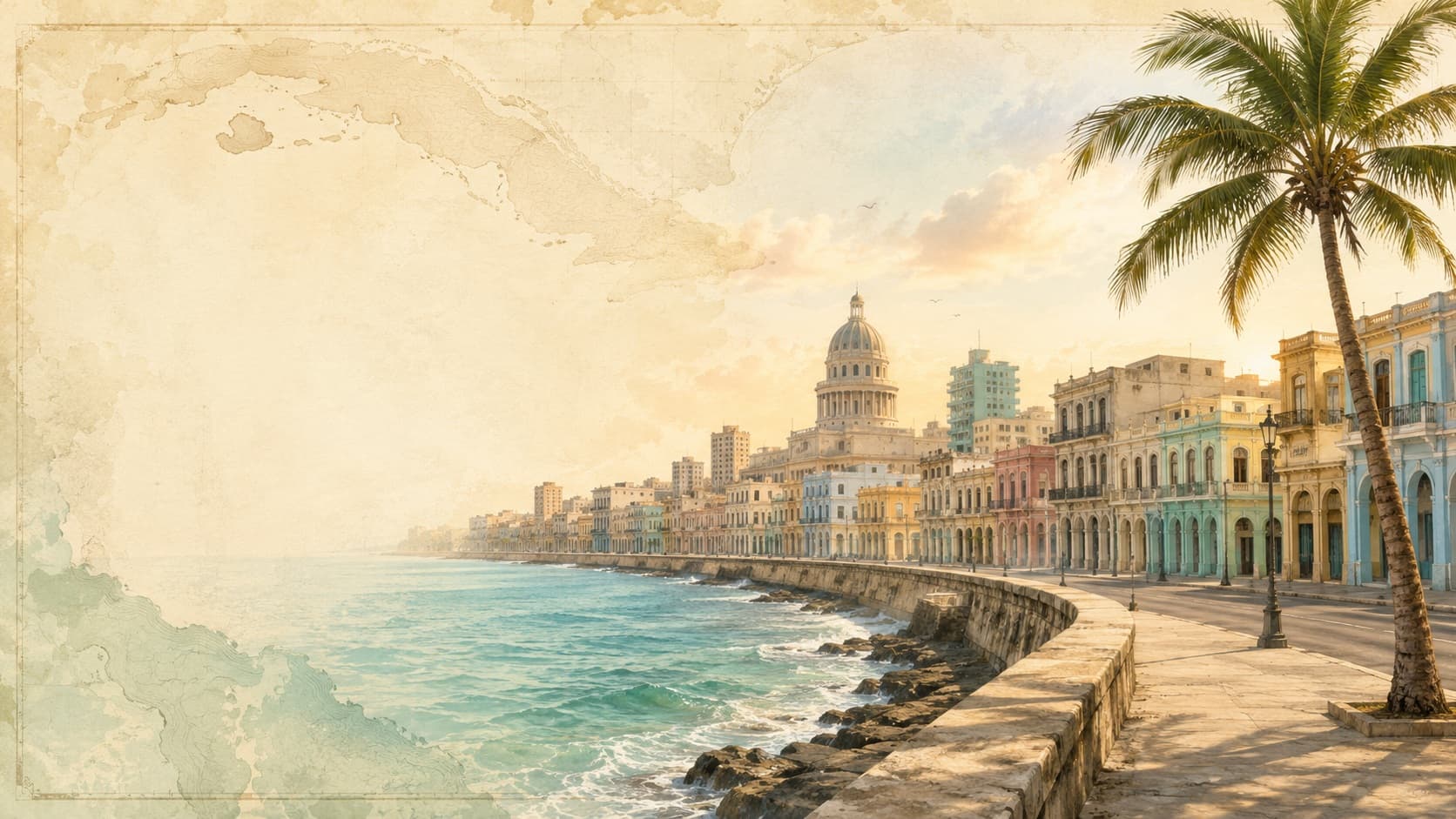
Cuba's capital and largest city — a place of faded grandeur, pastel architecture, and deep exile memory.
Eastern CubaSantiago de Cuba
The cradle of Cuban music and a center of revolution, history, and Afro-Cuban culture in the east.
Central CubaTrinidad
A beautifully preserved colonial town and UNESCO World Heritage Site built on the wealth of the sugar trade.
Have a question about Cuba?
Ask Dr. Elena Marquez directly. She explains Cuba’s history, culture, and current events.