
Cienfuegos
An elegant bayside city known as the “Pearl of the South,” famed for its French-influenced neoclassical architecture.
Cienfuegos, on Cuba's southern coast, is widely called the “Pearl of the South” (La Perla del Sur). Among Cuban cities it is unusual: founded in 1819 by French settlers from Louisiana and Bordeaux, it was laid out on an orderly grid and built in a graceful neoclassical style quite distinct from the baroque colonial look of older Cuban towns.
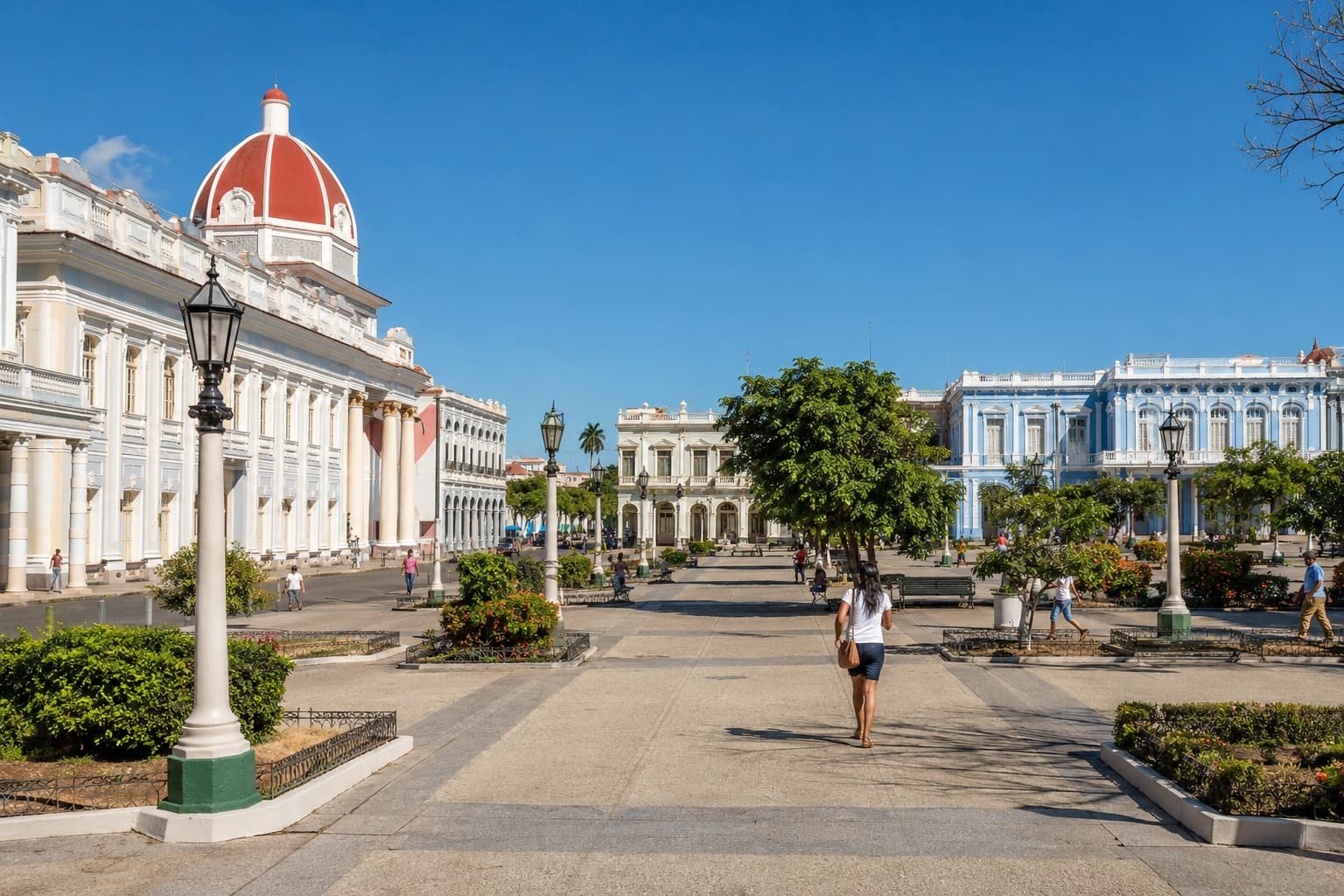
That French heritage gives Cienfuegos a measured, European elegance. Its historic center — the first 19th-century planned urban ensemble of its kind in Latin America — was inscribed as a UNESCO World Heritage Site in 2005, prized for the harmony of its architecture around the broad Parque José Martí.
From the central square radiates the Paseo del Prado, Cuba's longest boulevard, running down toward the waterfront and the leafy Punta Gorda district, where the eclectic Palacio de Valle stands as the city's most flamboyant building, blending Moorish, Gothic, and Venetian motifs.
Cienfuegos sits on one of the finest natural harbors in the Caribbean, and the sea has always shaped its life and economy — through sugar exports, shipping, and a large bayside industrial zone. The contrast between the refined colonial center and the working port is part of the city's character.
Cienfuegos also has a strong musical tradition, having produced renowned performers of Cuban classical and popular music; the celebrated singer Benny Moré is closely associated with the region. Relaxed, orderly, and quietly graceful, the city offers a different face of Cuba from the better-known intensity of Havana or Santiago.